Digital Marketing for Trades That Generates Qualified Leads and Booked Work

Generate more qualified enquiries, quote requests and booked work with digital marketing built for UK trade and home-service businesses. We help plumbers, heating engineers, electricians, roofers, builders, landscapers and other trades improve visibility across Google Search, Google Maps and paid search. Our approach focuses on the services you want to grow, the locations worth targeting and the channels most likely to reach customers who are ready to enquire.
★ ★ ★ ★ ★ 5.0
Based on 150+ Reviews
100%
U K. Based SEO
Team
Results
Driven
Oriented
Trades Trust Strip
TRUSTED BY TRADES BUSINESSES ACROSS THE UK
1,200+
Trade Businesses
Helped
4.9 / 5
Average Rating
on Google
250M+
Combined Leads
Generated
95%
Client Retention
Rate
6+ Years
Specialists in Trade
SEO
1,200+
Trade Businesses
Helped
4.9 / 5
Average Rating
on Google
250M+
Combined Leads
Generated
95%
Client Retention
Rate
6+ Years
Specialists in Trade
SEO

Why Your Digital Marketing May Not Be Generating Enough Leads

Digital marketing can look active while still underperforming commercially. The problem is often a disconnect between customer demand, service visibility, location relevance, trust and the path to enquiry.

You Are Not Visible for the Services That Matter

Customers cannot enquire about services they cannot find. Priority services such as boiler repairs, rewiring, roof repairs or other commercially important work need enough dedicated information to explain what the service is, who it is for, where it is available, why your business is suitable and how the customer can make an enquiry.

You Are Attracting the Wrong Enquiries

More leads do not automatically mean better marketing. Campaigns can underperform when enquiries come from locations you do not serve, relate to services you do not provide or concern work that is unlikely to become profitable. Stronger campaigns connect the right service with commercially valuable locations, genuine demand and the appropriate acquisition channel.

Customers Do Not Have Enough Reason to Trust You

Visibility gets your business considered, but trust influences whether the customer makes contact. Reviews, completed projects, photographs, case studies, qualifications, relevant accreditations, guarantees and clear business information should help customers quickly answer: Can you do the work? Do you serve my area? Can I trust you? How do I request a quote?

Your Website Does Not Match Customer Search Intent

Customers should reach information that matches what they searched for. Someone looking for roof repair should find roof repair information, while a customer searching for boiler installation or a local electrician should quickly understand whether the relevant service is available in their area. Strong landing pages reduce the distance between search intent and enquiry.

Your Marketing Channels Are Disconnected

SEO, Google Business Profile, Google Ads, website content, reviews and social channels should reinforce the same commercial message. Ads should lead to relevant landing pages, business profiles should reflect services supported by the website, and supporting content or case studies should connect naturally to the services they reinforce.

Not Sure Where the Problem Is?

If your marketing is generating visibility but not enough qualified enquiries, we can review your search presence, website structure, Google Business Profile, service coverage, trust signals and enquiry journey to identify where potential customers are being lost.

How Customers Find Tradespeople Online
Customers use several routes when looking for trade businesses, and the right marketing mix depends on the service, urgency, location, competition and commercial value of the work.

Google Search

Customers frequently search for specific services, jobs and problems. Searches such as boiler repair, emergency plumber, electrician near me, house rewiring, roof repair, bathroom installation, builder near me, consumer unit replacement and EV charger installation can carry strong commercial intent because the customer already has a requirement and is actively looking for someone to provide the service. Your website should therefore make the relationship between the business, the service, the location and the supporting evidence easy to understand.

Google Maps and Local Search

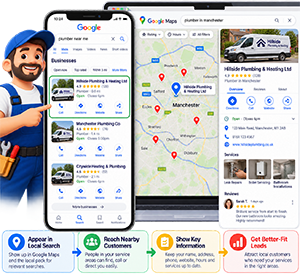
Local visibility is particularly important for service-area businesses. Google Business Profile and Google Maps can influence whether customers discover a business when searching within a particular area. Relevant local signals can include accurate business information, appropriate categories, clearly defined services, genuine customer reviews, photographs, website content, service-area information and consistent business details across relevant platforms. The website and Google Business Profile should reinforce the same core message: what you do, where you do it and why customers should consider you.

Google Ads and Paid Search

Google Ads can provide visibility for customers who are already searching for a relevant service. Paid search can be particularly useful for urgent services, commercially valuable work, new service launches or markets where the business needs visibility before organic rankings have developed. Campaign performance depends on much more than keyword selection. Geographic targeting, negative keywords, customer intent, ad copy, landing-page relevance, call tracking, conversion tracking, lead quality and budget allocation all influence whether paid traffic produces commercially useful enquiries. The relationship should remain clear: specific search → relevant advert → matching landing page → clear next step

Reviews and Third-Party Platforms

Some customers discover a business through search and then validate it elsewhere. They may read Google reviews, examine social profiles, check trade directories, verify business information or look for previous project evidence. Platforms such as Checkatrade, MyBuilder, Rated People and relevant local directories can influence customer discovery or validation. These platforms should reinforce the business rather than compensate for an unclear website.

AI-Assisted Search and Answer Systems

Search behaviour is also expanding beyond traditional search-result pages. AI-assisted systems can interpret questions, retrieve information from multiple sources and present summarised responses. Terms such as Answer Engine Optimisation, AEO, Generative Engine Optimisation, GEO and AI search visibility are increasingly used to describe parts of this environment. These should not be treated as completely separate marketing disciplines. Their foundations overlap heavily with good search optimisation: clear service definitions, consistent business information, direct answers, structured website architecture, strong supporting evidence, contextual internal linking, useful content and information that retrieval systems can understand. The broader objective remains search visibility, whether discovery takes place through traditional organic search, Google Maps or AI-assisted systems.

Our Digital Marketing Services for Tradespeople

Different trade businesses require different combinations of channels. We build campaigns around the commercial problem that needs to be solved rather than automatically recommending every available service.

SEO for Tradespeople

Search Engine Optimisation helps relevant pages become more visible when potential customers search for the services you provide. SEO work can include search-intent research, competitor analysis, service-page optimisation, technical SEO, internal linking, content improvement, Local SEO, website architecture, authority development and ongoing performance analysis. The objective is not simply to increase keyword positions. It is to improve visibility for searches that have a realistic opportunity to generate relevant enquiries.

Local SEO for Tradespeople

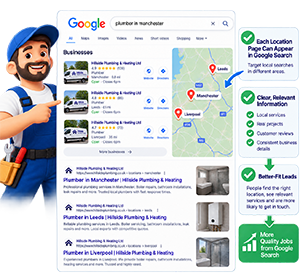
Local SEO focuses on customers searching within the areas your business genuinely serves. This can involve Google Business Profile optimisation, Google Maps visibility, local keyword research, service-area information, review strategy, relevant citations, location pages where justified, internal linking and consistent business information. A strong local strategy should make it easy for customers and search systems to understand which services you provide and where those services are available.

Google Ads and PPC Management

Paid search can place your business in front of customers who are already searching for relevant services. Campaign management can include keyword targeting, negative keywords, geographic targeting, ad copy, landing-page alignment, call tracking, form tracking, budget management, search-term analysis and enquiry-quality review. The relationship should remain clear: customer search → relevant advert → matching service page → enquiry

Website Optimisation for Trade Businesses

A trade website should make it easy for customers to understand your services and take action. Important improvements can include clearer service architecture, dedicated specialist pages, mobile usability, site performance, internal linking, trust evidence, calls to action, quote forms, telephone enquiry paths and conversion-focused landing pages. A trade website should not operate as a passive online brochure. It should function as part of the customer acquisition system.

Content Marketing

Content should support genuine customer questions and commercially important services. Useful content can include specialist service pages, FAQs, cost guides, process explanations, maintenance advice, comparison content, completed projects, case studies and location information where a genuine local relationship exists. Every piece of content should have a defined role. Informational content should normally support a relevant commercial service rather than exist solely to increase page count.

AI Search, AEO and GEO

Answer-focused optimisation makes important information easier for search and retrieval systems to identify. That can involve answering genuine questions directly, using clear service terminology, creating logical content hierarchies, connecting supporting information to relevant commercial pages, strengthening business-entity consistency and adding credible supporting evidence. AEO and GEO should strengthen the wider search strategy rather than become separate collections of keywords and acronyms.

Lead Tracking and Measurement

Marketing decisions improve when lead quality can be measured. Depending on the campaign and available systems, tracking can include telephone enquiries, contact forms, quote requests, lead source, service requested, customer location, cost per enquiry, conversion rate, quote opportunity and booked work where attribution is reliable. The most useful question is not simply how much traffic the website received. It is whether the marketing generated commercially useful opportunities.

Website Architecture for Trade Businesses

Website structure affects customer navigation, crawling, internal relevance and search-engine understanding.

A trade website should establish clear relationships between the business, its main services, specialist services, service areas and supporting evidence.

A useful conceptual structure is:
business → core service → specialist service → location → supporting evidence
⌂ Business ▦ Core Service ⚙ Specialist Service ⌖ Location ▤ Supporting Evidence
1

Core Service Pages

Core service pages represent broader categories of work.

A plumbing and heating business might have main sections for plumbing, heating, boilers and emergency services.

These pages introduce the broader service category and connect customers to more specialised services.

2

Specialist Service Pages

Commercially important services often deserve dedicated pages where customer intent differs substantially.

Boiler installation, boiler repair, house rewiring, consumer unit replacement, flat roof repair, roof replacement, bathroom installation and EV charger installation are examples of services that may justify dedicated treatment.

A specialist page should answer questions specifically relevant to that service instead of repeating generic company information.

3

Location and Service-Area Pages

Location pages can be useful when a business genuinely serves several towns, cities or regions.

They should not be created purely because a location has keyword volume.

A useful local landing page should demonstrate a genuine relationship between the business, the service and the location, while providing enough useful information to justify its existence.

Changing only the town name across hundreds of otherwise identical pages is not a strong local SEO strategy.

4

Supporting Content

FAQs, guides, cost information, maintenance advice and project content should support the commercial services they relate to.

A useful relationship is:

commercial service → relevant customer question → supporting answer → commercial next step
5

Case Studies and Completed Projects

Completed-project content can provide strong first-party evidence.

Useful project pages can explain the customer's requirement, the service provided, the location where appropriate, relevant challenges, the work completed and the outcome.

Photographs and genuine customer feedback can strengthen that evidence further.

6

Internal Linking

Internal links should reinforce the site's information architecture.

Core pages should connect to specialist services. Specialist service pages can connect to relevant FAQs, cost guides, project examples, justified location pages and related services. Supporting content should direct customers back towards the service that solves the problem being discussed.

The objective is a connected information architecture rather than a collection of isolated keyword pages.

Digital Marketing for Different Trades

Trade and home-service businesses share certain marketing principles, but search behaviour, customer risk and buying cycles can vary significantly between sectors. The strategy should reflect those differences.

Plumbers and Heating Engineers

Plumbing and heating customers may require emergency repairs, general plumbing, boiler installation, boiler repair, heating system work or ongoing maintenance. Urgency, job value and customer intent differ considerably between these services. Marketing architecture should reflect those differences instead of treating plumbing and heating as one generic topic.

Electricians

Electrical contractors may provide fault finding, emergency electrical work, rewiring, consumer unit replacement, electrical testing, EICRs and EV charger installation. Where these services represent distinct customer needs, they should be clearly differentiated across the website and marketing campaigns.

Roofers

Roofing customers may require emergency repairs, flat roof work, pitched roofing, roof replacement or specialist roofing systems. Photographs, completed-project pages and reviews can be particularly important because customers often want visible evidence of previous work.

Builders

Building projects frequently involve larger budgets, longer decision cycles and greater perceived customer risk. Potential customers may compare several contractors, inspect previous projects and assess credibility before requesting a quote. Strong project evidence, reviews and clear service information therefore become particularly important.

Landscapers and Gardeners

Landscaping businesses may generate demand for patios, fencing, turfing, garden design, maintenance and larger outdoor projects. Visual evidence can play an important role because customers often want to assess workmanship and style before requesting a quotation.

Other Trade Businesses

The same principles can apply to carpenters, joiners, plasterers, tilers, locksmiths, HVAC contractors, painters, decorators, flooring contractors, drainage specialists, kitchen fitters, bathroom fitters and other specialist home-service businesses. The marketing structure should reflect the actual customer journey for the trade rather than reuse the same template across every industry.

Digital Marketing for the Areas You Serve

Geographic targeting should reflect where the business can realistically and profitably provide its services. More reach does not automatically mean more commercial opportunity.

Local Service Areas

Many trade businesses operate within one town or a small group of nearby locations. Marketing should make those areas clear without creating unnecessary location pages.

Regional Campaigns

Higher-value services may justify wider geographic coverage. A specialist installation or larger construction project may support a larger service radius than a small repair. Geographic strategy should therefore consider average job value, competition, travel requirements, conversion probability, labour capacity and commercial viability.

Multi-Location Businesses

Businesses operating across several genuine markets may require location-specific landing experiences. Those locations should represent real operating areas rather than artificial SEO targets.

UK-Wide Services

Some specialist trade businesses operate nationally. In those situations, a national service structure may be supported by regional or local information where delivery, teams, services or customer requirements genuinely differ.

Why Trade Businesses Contact Us

Trade businesses usually contact us because something in their current acquisition system is underperforming. They may be receiving traffic but too few enquiries, ranking for some terms but not their most valuable services, attracting enquiries from the wrong locations, spending money on Google Ads without understanding lead quality, or operating a website that has grown without a clear service structure. Others have a Google Business Profile that generates limited visibility, a large number of location pages with weak local relevance, or informational content that attracts visitors without supporting commercial services. Some businesses simply have SEO, Local SEO, PPC, content and website activity operating independently. In each case, the first step is not automatically to add more pages, increase advertising spend or publish more content. The first step is to identify the constraint.

Evidence Before Recommendations

Marketing recommendations should be based on evidence rather than generic packages. Before recommending changes, we can examine existing organic visibility, priority service rankings, competitor positioning, Google Business Profile, website architecture, service-page coverage, local landing pages, conversion paths, trust signals, call and form tracking and lead quality where reliable data is available. This helps distinguish between different types of problems. Low visibility may require stronger search optimisation. Strong visibility but weak enquiry volume may indicate a conversion or trust problem. High enquiry volume but poor lead quality may indicate targeting or intent issues. Paid traffic without commercially useful enquiries may point to keyword selection, location targeting, landing-page relevance or measurement problems. The correct intervention depends on the actual constraint.

Our Digital Marketing Process

01

Understand the Business and Priority Services

We begin by identifying the work the business actually wants more of. That can include priority services, higher-value jobs, service areas, seasonality, average job value, existing lead sources, business capacity and current marketing performance. This helps avoid investing in traffic with little commercial value.
02

Analyse Search Demand and Competitors

We examine how customers search for the priority services and how competing businesses represent themselves. Research can include search intent, service demand, local visibility, competitor landing pages, website architecture, paid-search activity, customer questions, review patterns and SERP composition.
03

Identify the Main Constraint

Not every business has the same problem. The main constraint may be insufficient visibility, weak local relevance, poor service-page coverage, technical SEO issues, weak conversion, insufficient trust, ineffective paid search or inadequate measurement. The campaign should address the constraint rather than simply increase activity.
04

Build the Required Campaign Structure

The appropriate strategy may involve SEO, Local SEO, Google Ads, website optimisation, service pages, location pages, supporting content, trust improvements, internal linking or lead tracking. The mix depends on the commercial opportunity.
05

Improve the Required Assets

Implementation can involve improving existing pages, creating missing service content, strengthening website structure, improving local relevance, optimising Google Business Profile, building appropriate landing pages, improving internal links and strengthening enquiry paths.
06

Track Qualified Enquiries

Where possible, we assess which channels, pages, services, search terms and locations generate useful enquiries. Call and form volume matters, but lead relevance matters more.
07

Improve What Produces Better Opportunities

Ongoing optimisation should be based on evidence. That may involve adjusting keywords, geographic targeting, landing pages, internal linking, calls to action, content, paid budgets, trust signals or service focus. The objective is to increase the commercial value of the opportunities being generated.

What the First 90 Days Can Look Like

The exact work depends on the starting position of the business.
Days 1–30

Research and Foundations

The first stage can involve analysing priority services, commercially viable locations, competitor positioning, current rankings, Google Business Profile, website architecture, tracking, technical issues and trust signals. Technical or structural issues restricting visibility should be identified early.
Days 31–60

Improve Priority Assets

The next stage can involve strengthening priority service pages, improving local relevance, repairing internal linking, creating required landing pages, refining paid-search campaigns, improving calls to action and adding missing trust evidence. Relevant customer questions can also be addressed where supporting content is required.
Days 61–90

Measure Lead Quality and Refine

Once sufficient data exists, attention can move towards the quality of the enquiries being generated. This can include analysing the service requested, customer location, quote potential, cost per lead, conversion rate, search terms and booked work where attribution allows. Further expansion should follow evidence rather than automatically adding more services, locations or content.

Digital Marketing Mistakes That Cost Tradespeople Leads

Trying to rank every service through one generic page can make it harder to establish relevance for individual customer needs. Creating hundreds of near-identical location pages can produce weak content and an unclear site structure. Sending paid traffic to a generic homepage rather than a relevant landing page can reduce conversion potential. Publishing large quantities of informational content without connecting it to commercial services can increase page count without strengthening the customer journey. Treating SEO, Local SEO, PPC, website content and AI search as completely separate strategies can fragment the business’s online presence. Focusing exclusively on rankings can also hide the most important issue: whether the marketing is generating enquiries that can realistically become profitable work.

Why Choose SEO for Trades UK?

Focused on Trade and Home-Service Businesses

Trade businesses have different acquisition requirements from ecommerce stores, software companies and national retailers. Most need to generate demand for specific services within commercially viable geographic areas. Our approach is structured around that relationship: service demand + location + customer intent + evidence + enquiry

Commercial Priorities Before Vanity Metrics

Rankings and traffic help diagnose performance, but they are not the final commercial objective. Marketing decisions should consider service relevance, customer location, lead quality, quote potential and booked work where measurable.

Search, Local and Paid Visibility Working Together

Customers may discover your business through Google Search, Google Maps, Google Ads, reviews, trade directories, social media or AI-assisted search.
Those channels should reinforce consistent information rather than present disconnected versions of the company.

Clear Website Architecture

We structure content so customers and search systems can understand the relationships between main services, specialist services, service areas, customer questions, supporting information and completed projects.

This helps reduce duplication, generic pages and arbitrary internal linking.

Evidence Where It Matters

Claims should be supported with genuine evidence wherever possible.
Relevant evidence can include reviews, completed-project photographs, customer feedback, qualifications, accreditations, guarantees, case studies and measurable marketing results.

Decisions Based on Lead Quality

A campaign generating ten highly relevant quote opportunities can be more commercially valuable than one generating fifty unsuitable enquiries.

That is why customer intent, service relevance, location and quote potential should influence optimisation decisions.

Digital Marketing Pricing for Tradespeople

Digital marketing costs vary depending on the services you want to grow, the locations you want to target, competition, website requirements, advertising spend and the level of ongoing optimisation required. Some trade businesses may only need focused SEO or paid search support, while others require a broader combination of website improvements, Local SEO, content, tracking and campaign management.

Related Digital Marketing Services

This page provides the overall digital marketing framework for trade businesses. Specialist services can go deeper into individual acquisition channels and areas of optimisation.

SEO for Tradespeople

Organic search strategy covering search intent, service-page optimisation, technical SEO, internal linking, content and authority development.

Local SEO for Tradespeople

Local visibility covering Google Business Profile, Google Maps, customer reviews, citations, service areas and local relevance.

Google Ads for Tradespeople

Paid search management covering keywords, search terms, geographic targeting, negative keywords, ad copy, landing pages, budgets and conversion tracking.

Website Design and Optimisation for Tradespeople

Website architecture, usability, performance, service pages, trust signals and enquiry paths designed around lead generation.

Content Marketing for Tradespeople

Service content, guides, FAQs, case studies, project content and useful customer answers connected to commercial services.

Social Media Marketing for Tradespeople

Project photographs, before-and-after content, reviews, business updates, social proof and paid social campaigns where commercially appropriate.

Digital Marketing for Tradespeople FAQs

Digital marketing for tradespeople uses channels such as SEO, Local SEO, Google Ads, websites, content, reviews and social media to help trade businesses attract relevant customers online. The strongest strategies connect customer demand with the right services, locations, proof and enquiry paths.
Digital marketing can improve visibility for the services customers are already searching for, strengthen trust and make it easier for suitable prospects to contact the business. The objective is not simply more traffic, but more qualified enquiries, quote opportunities and booked work.
SEO and Google Ads serve different purposes. SEO builds organic visibility over time, while Google Ads can generate paid visibility when customers are actively searching for specific services. Some trade businesses benefit from both, while others should prioritise one based on competition, budget, service value and existing visibility.
There is no fixed timeframe. Results depend on competition, website quality, existing authority, service demand, location, budget and the marketing channel being used. Paid campaigns can generate visibility quickly, while meaningful SEO growth usually develops over a longer period.
Cost depends on the services being promoted, target locations, competition, advertising spend, website requirements, content needs, tracking and ongoing management. The right budget should reflect the commercial value of the work you want to generate rather than a generic marketing package.
No. Dedicated pages are most useful for commercially important services with distinct customer intent. A clear website structure usually moves from broader service categories to priority individual services rather than creating unnecessary pages for every minor variation.
No. Location pages should only exist where the business genuinely serves the area and there is enough useful information to justify a dedicated page. Near-identical pages created only by changing town names add little value.
Potentially, but no agency can guarantee inclusion or recommendation by a specific AI system. Clear service information, consistent business details, relevant third-party references, credible proof and well-structured content can make the business easier for search and retrieval systems to understand.
SEO focuses primarily on organic search visibility, AEO on making information clear for answer-based systems, and GEO on visibility within generative search environments. In practice, there is substantial overlap, so these should usually support one broader search and discovery strategy rather than operate as completely separate disciplines.
Yes. Genuine and relevant reviews can strengthen trust when customers compare trade businesses, particularly when the feedback relates to a specific service, project or location. Quality, relevance and recency are usually more valuable than review volume alone.
Useful measures include qualified phone calls, form submissions, quote requests, service requested, customer location, lead source, cost per lead, conversion rate, quote opportunities and booked work where reliable attribution is available. Rankings, impressions and traffic help diagnose performance, but commercial outcomes determine whether the marketing is actually working.

Find Out Where Your Marketing Is Losing Qualified Leads

If your website, Google visibility or paid campaigns are not generating enough of the right enquiries, we can identify the areas most likely to be holding performance back.

Tell us which services you want more work for, the locations you serve and where your current marketing is underperforming.