
Social Media Marketing for Trades That Brings More Local Enquiries

Attract more local enquiries for the trade services you want to grow. SEO for Trades combines social media management, project-led content and paid advertising to help UK trade businesses reach homeowners and businesses in their service areas. We showcase your completed work, build trust and turn interest into quote requests.

★ ★ ★ ★ ★ 5.0
Based on 150+ Reviews
100%
U K. Based SEO
Team
Results
Driven
Oriented
Trades Trust Strip
TRUSTED BY TRADES BUSINESSES ACROSS THE UK
1,200+
Trade Businesses
Helped
4.9 / 5
Average Rating
on Google
250M+
Combined Leads
Generated
95%
Client Retention
Rate
6+ Years
Specialists in Trade
SEO
1,200+
Trade Businesses
Helped
4.9 / 5
Average Rating
on Google
250M+
Combined Leads
Generated
95%
Client Retention
Rate
6+ Years
Specialists in Trade
SEO

Social Media Marketing Built Around the Jobs You Want to Win

A trade business does not need more social media activity unless that activity supports a commercial objective.

Before deciding what to post or advertise, we identify: the services you want more enquiries for, the jobs that are commercially valuable to your business, the customers most likely to buy those services, the locations where you want more work, the proof customers need before contacting you, and the most appropriate enquiry route.

A roofer trying to win more roof-replacement projects needs a different campaign from a plumber promoting emergency repairs or an electrician targeting commercial contractors.

That is why the campaign starts with the service and customer, not with a posting calendar.

Why Social Media Fails to Generate Leads for Many Trade Businesses

Having active Facebook or Instagram accounts does not automatically produce enquiries. Social media usually underperforms when the business is posting without a clear connection between the service being promoted, the customer being targeted, the evidence being shown and the action the customer should take next.

Your Content Does Not Clearly Promote Priority Services

Generic company updates, motivational posts and unrelated content may keep a profile active, but they do little to help a potential customer understand what they can hire you for. If a roofer wants more roof-replacement work, the content should consistently show roof replacements, explain relevant customer problems, demonstrate completed jobs and provide a clear route to request a quote. The same principle applies to every trade: the content should make the service being sold easy to identify.

Your Social Media Does Not Provide Enough Proof

Trade services are trust-based purchases. Before making contact, customers often want evidence that the business can complete the work properly. Useful proof can include completed projects, before-and-after photographs, customer reviews and testimonials, work-in-progress content, short videos, explanations of how a job was completed, and examples of similar work in the customer’s area. A photograph is more useful when the customer can understand what work was completed, what problem was solved and whether you provide the same service locally.

You Are Reaching the Wrong People

Large reach does not necessarily mean useful reach. A local roofing, plumbing, electrical, building or landscaping business usually needs customers within a practical service area. Paid social advertising can help distribute specific services and proof to selected audiences rather than relying entirely on existing followers. Audience quality matters more than raw impressions.

Organic and Paid Social Media Are Working Separately

Organic and paid social media perform different jobs. Organic social media builds an ongoing body of evidence around your business through completed projects, reviews, service information, videos and regular updates. Paid social advertising gives selected services, offers and proof additional distribution to relevant audiences. The two work best together. A customer may see an advertisement and then visit your profile before making contact. A strong organic presence can help validate the claims made in the advert and reduce uncertainty.

Customers Do Not Have a Clear Next Step

Good project content can create interest, but customers still need an obvious way to act. Depending on the campaign, the next step may be to call the business, send a direct message, request a quote, submit an enquiry form, book an assessment or visit the relevant service page. Every campaign should have a defined conversion route.

You Are Optimising for Activity Instead of Lead Quality

Not every enquiry has the same value. You may want more full installations rather than small repairs, planned projects rather than emergency work, domestic projects rather than commercial contracts, or higher-value work in selected locations. Campaign decisions should therefore be judged against qualified enquiries, quote opportunities and booked work, not just followers, likes or reach.

How Customers Find and Choose
Tradespeople Online

Most customers do not hire a trade business after seeing one post.

They are more likely to move through a short decision process:

discover the business → confirm the service → review proof → check location → assess trust → make an enquiry

Social media supports that journey at several points.

A customer may first discover your business through Facebook, Instagram, Google, a recommendation, a directory or another platform. They may then use your social profiles to check whether you complete the type of work they need, whether you appear active, whether other customers trust you and whether you work in their area.

This means your social profiles should answer five questions quickly:

  1. What services do you provide?
  2. What does your work look like?
  3. Who do you work for?
  4. Where do you work?
  5. How can someone request a quote?

What Our Social Media Marketing Service Includes

Our campaigns combine the activities required to attract relevant customers, demonstrate the quality of your work and turn interest into enquiries.

Organic Social Media Management

We plan, prepare and publish content around your actual services, completed work, customer proof and current commercial priorities. Organic content can include completed-project posts, before-and-after content, customer reviews and testimonials, service-specific posts, work-in-progress updates, short-form video and Reels, useful customer information, seasonal service content, and local project examples. The aim is to build a profile that helps a potential customer understand what you do and whether you are credible enough to contact.

Social Media Content Creation

We turn suitable business material into content that connects a specific service with a specific customer need. Content can be created from project photographs, before-and-after images, video clips, completed installations, repairs and renovations, customer feedback, service explanations, frequently asked customer questions, and seasonal campaigns. Where the same asset is useful for both organic and paid activity, it can support both parts of the campaign.

Paid Social Media Advertising

Paid social advertising can extend selected services and proof beyond your existing followers. Campaigns can be structured around a priority service, a defined customer type, a defined geographical area, a specific offer or message, and a clear enquiry action. The objective is controlled customer acquisition rather than broad, untargeted reach.

Facebook Advertising for Trade Businesses

Facebook can be useful for reaching homeowners and local audiences, particularly when the service can be supported by project proof, reviews and clear service-area messaging. Depending on the campaign, customers can be directed to a lead form, Messenger, a relevant service page, a quote-request page, a phone call, and an assessment request. Facebook can also support local visibility through business pages and relevant community activity, but paid campaigns should still be built around a defined commercial objective.

Instagram Marketing and Advertising for Trades
Instagram is particularly useful where the quality or transformation of the work can be shown visually. Builders, roofers, landscapers, decorators, kitchen fitters and similar trades can use: before-and-after imagery, project carousels, short-form video, Reels, work-in-progress clips, completed-project showcases, and customer proof. Instagram should not be selected simply because it is popular. It is most useful when the target customer and the visual nature of the service justify it.

LinkedIn for Commercial and B2B Trades

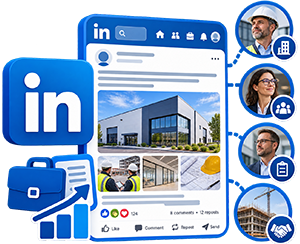
LinkedIn can be more relevant where the target customer is a business rather than a homeowner. Potential audiences can include contractors, property managers, facilities teams, developers, commercial landlords, and procurement or operational decision-makers. For B2B trades, content should focus less on consumer-style promotion and more on project capability, commercial experience, compliance where relevant, case studies and the type of contracts the business wants to win.

TikTok and Short-Form Video

TikTok and short-form video can create reach when the work is visually interesting or educational. Potential formats include transformations, job progress, common mistakes, quick service explanations, behind-the-scenes work, and tool or process demonstrations. However, high reach is not automatically useful for a local service business. The platform should only receive meaningful effort when its audience and distribution model fit the campaign objective.

Local Audience and Service-Area Targeting

Trade businesses usually need leads from areas where they can realistically complete the work. Campaign targeting can consider towns and cities, postcode areas, radius targeting, service value, travel practicality, customer type, and commercial fit. A higher-value installation may justify a larger service area than a smaller repair job. Location strategy should therefore be connected to the service being promoted.

Remarketing and Re-Engagement

Not every potential customer enquires after the first interaction. Where technically appropriate, paid campaigns can re-engage people who have already shown relevant interest and present additional service information, proof or reminders. Remarketing is most useful when it supports a clear conversion path rather than simply repeating the same advert.

Community and Enquiry Management

Potential customers may contact a trade business through comments or direct messages before using a website form.

Routine interactions can include service questions, location questions, availability questions, requests for estimates, quote enquiries, and questions about the next step.

Where included in scope, these enquiries can be routed into the business so that relevant opportunities move towards a sales conversation.
Campaign Reporting and Lead Optimisation

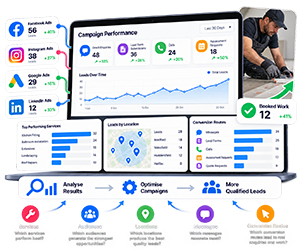
Where reliable tracking is available, we focus on commercially useful outcomes such as direct enquiries, lead-form submissions, messages, calls, quote requests, assessment requests, qualified opportunities, and booked work where attribution is possible.

Campaign optimisation should answer a practical question:

Which services, audiences, locations, messages and conversion routes are producing the strongest lead opportunities?

How We Turn Social Media Interest Into Qualified Enquiries

Generating attention is only the first stage.

A useful campaign connects the complete path:

service interest
proof
customer action
enquiry
qualification
quote
booked work
1

Service-Specific Campaign Messaging

The customer should immediately understand: what service is being promoted, who the service is for, what problem or requirement it addresses, where the service is available, what evidence supports the claim, and what they should do next.

A roof-replacement advert should lead into roof-replacement proof and a roof-replacement enquiry route. Sending every campaign to a generic homepage weakens that continuity.

2

Clear Calls to Action

Calls to action can include call for an initial discussion, send a direct message, request a quote, submit an enquiry form, book an assessment, and visit the relevant service page.

The correct action depends on how the trade business actually sells the service.

3

Quote and Enquiry Forms

Where forms are used, useful fields can include required service, project location, contact details, brief project description, preferred contact method, and expected timing.

The aim is to collect enough information to start qualification without creating unnecessary friction.

4

Lead Qualification

More leads do not automatically mean better results.

Lead quality can be assessed using service required, customer location, project type, job value, timing, customer fit, and whether the business can perform the work.

This helps separate casual interactions from genuine sales opportunities.

5

Lead Follow-Up

Marketing cannot turn an enquiry into booked work if nobody follows it up.

Depending on the business, follow-up can include confirming the required service, checking the location, requesting additional project information, arranging a call, booking a site visit, preparing a quotation, and following up after the quotation.

The social media campaign and the sales process need to connect.

6

Lead Tracking and Attribution

Where technically possible, enquiries can be connected back to the platform, campaign, service, advert, landing page, form, and call source.

This allows future campaign decisions to be based on commercial outcomes rather than surface-level engagement metrics.

Social Media Marketing for Different UK Trades

Different trades sell different services, attract different customers and rely on different forms of proof. The campaign should adapt accordingly.

Social Media Marketing for Plumbers

Plumbing businesses may offer a mixture of urgent work, planned services and higher-value installations. Relevant content can include plumbing repairs, bathroom installations, pipework, heating-related work where offered, completed installations, maintenance, and customer reviews. Campaigns should separate services with very different customer intent rather than treating all plumbing enquiries as equivalent.

Social Media Marketing for Electricians

Relevant content can include electrical installations, rewires, lighting projects, consumer-unit work, commercial electrical projects, inspection-related services where offered, and completed-project proof. For commercial electricians, LinkedIn and B2B-focused content may be more useful than a purely homeowner-led strategy.

Social Media Marketing for Roofers

Relevant content can include roof replacements, roof repairs, flat roofing, pitched roofing, leadwork, completed projects, before-and-after photographs, work-in-progress video, and reviews. A campaign promoting roof replacement should show roof-replacement proof and send customers to a matching enquiry route rather than a generic roofing message.

Social Media Marketing for Builders

Builders often need to demonstrate larger projects, workmanship and the ability to manage complex work. Useful content can include extensions, renovations, conversions, structural work, new-build projects, project progress, completed interiors and exteriors, and customer testimonials. For larger projects, customers often need repeated proof before making contact, so case-study style project content can be particularly valuable.

Social Media Marketing for Landscapers and Gardeners

Landscaping is particularly suited to visual social content. Useful assets can include garden transformations, patios, paving, fencing, lawns, planting, garden design, maintenance work, and before-and-after projects. Seasonality and project value can strongly influence which services deserve paid promotion.

Social Media Marketing for Heating and HVAC Businesses

Content can include installations, servicing, maintenance, upgrades, completed projects, customer reviews, and seasonal reminders. Seasonal demand can be used to adjust campaign emphasis when there is a genuine relationship between timing and customer need.

Social Media Marketing for Painters and Decorators

Relevant content can include interior decorating, exterior painting, completed rooms, before-and-after projects, preparation work, commercial decorating, and customer feedback. The visual quality of finished work makes this category particularly suitable for Instagram, Facebook and short-form video.

Other Local Trades

The same framework can be adapted for: joiners and carpenters, plasterers, tilers, flooring contractors, kitchen fitters, bathroom fitters, fencing contractors, driveway contractors, property-maintenance businesses, and other specialist trades.

Local Social Media Advertising Across Your Service Area

Local relevance should qualify leads, not simply add place names to the campaign.

Define Where You Actually Want Work

A service area may include specific towns, cities, postcode areas, surrounding districts, a defined radius, and several commercially important locations. The useful question is not “How far can we target?” but “Where can this business profitably complete this type of work?”

Match Each Service to the Right Geographic Area

Not every service needs the same geographic coverage. A higher-value project may support a wider travel area. Lower-value or urgent work may require a tighter radius. Paid targeting, social profile information, landing pages and enquiry forms should therefore reinforce the same geographic expectations.

Use Local Project Proof

Where appropriate and authorised, completed projects can mention the area in which the work was carried out.
For example:
Completed landscaping project in [location]
That gives the customer both service proof and local relevance without manufacturing location pages or inserting irrelevant place names.

Multi-Location Trade Businesses

For businesses operating across several areas, campaigns may need separate: service priorities, geographic targeting, budgets, creative, local proof, enquiry routes, and performance analysis. The objective is to understand which combinations of service and location are generating commercially useful enquiries.

Our Social Media Lead-Generation Process

We use a six-stage process rather than treating content, advertising and reporting as separate activities.
01

Define the Commercial Objective

We identify: priority services, preferred job types, target customers, target locations, services that should not be prioritised, and the desired enquiry action.
02

Audit the Existing Social Presence

We review relevant areas such as profile information, service descriptions, contact details, existing content, project proof, reviews and testimonials, platform suitability, previous paid campaigns, enquiry routes, and available tracking.
03

Build the Audience, Content and Platform Strategy

We match the service to the appropriate customer, the practical service area, the most useful platform, the content and proof required, and the conversion route.
04

Create and Launch the Campaign

Depending on scope, this can include captions, project posts, graphics, video, testimonials, paid-ad creative, lead forms, landing-page destinations, and calls to action.
05

Manage and Track Enquiries

We monitor the available campaign data and, where included, help route comments, messages and enquiries into the business. The focus remains on lead quality rather than raw activity.
06

Optimise and Scale What Works

Campaigns can be adjusted based on service performance, lead quality, audience response, location performance, creative performance, calls to action, conversion routes, and budget allocation. Scaling should follow evidence rather than assumptions.

What the First 90 Days Can Look Like

The first 90 days are generally used to establish the campaign, generate useful data and improve the combinations showing the strongest commercial potential.
Days 1–30

Strategy and Setup

Typical work can include confirming priority services, defining customer groups, confirming service areas, reviewing existing profiles, identifying available project proof, setting up content and paid-campaign structures, and checking enquiry routes and available tracking.
Days 31–60

Publishing and Campaign Testing

This period can test combinations of: service, customer type, location, message, content format, call to action, and enquiry route. The aim is not to declare a winner after a few clicks. It is to identify patterns in the enquiries being generated.
Days 61–90

Lead-Quality Review and Optimisation

We review which combinations are producing stronger opportunities and adjust the campaign accordingly. Useful questions include which services generate the best enquiries?, Which locations produce serviceable leads?, Which customer groups respond?, Which project examples support conversion?, Which calls to action lead to useful quote requests?, and Which paid campaigns justify additional budget?. There is no universal guarantee that a specific number of leads will be generated within 90 days. Performance depends on the service, area, offer, proof, budget, market demand and sales follow-up.

Social Media Campaign Results

A results section is only useful when it contains evidence.

Before publishing this page, add at least one verified trade campaign example if you have permission to use it. The strongest case study would include trade and service promoted, target area, campaign objective, campaign duration, channels used, type of content or creative, qualified enquiries generated, quote opportunities, booked jobs where tracked, cost per qualified enquiry where reliable, and attributable revenue only where it can be supported.

Do not publish invented numbers or generic placeholder results. If verified performance data is not yet available, leave the case study off the public page and use genuine project examples, client testimonials or other verifiable proof instead.

What Is Included in Our Social Media Management Service

Exact scope depends on the agreed campaign, but services can include:

Strategy and Account Review

This can include priority-service planning, target customer definition, service-area planning, platform selection, profile review, campaign messaging, and enquiry-route planning.

Organic Social Media Management

This can include content planning, captions, project posts, before-and-after posts, customer reviews, service content, educational content, seasonal content, short-form video where included, and scheduling.

Paid Social Campaign Management

This can include campaign setup, Facebook advertising, Instagram advertising, service-specific messaging, advertising creative, audience targeting, geographic targeting, lead-generation campaigns, remarketing where appropriate, and ongoing optimisation.

Enquiry Routes and Tracking

Depending on the campaign, we can work with platform lead forms, direct messages, phone calls, website enquiry forms, quote-request pages, service pages, and campaign-specific landing pages.

Reporting and Optimisation

Where reliable data is available, reporting can cover enquiries, lead forms, messages, calls, quote requests, paid campaign performance, lead quality, service performance, and location performance.

What We Need From Your Trade Business

Strong social campaigns depend on real business material. Useful inputs can include service information, service areas, project photographs, before-and-after imagery, video, customer reviews, testimonials, current offers where relevant, availability information, project details, and content approval where required. If you do not have enough content, we can structure a practical plan around the material that is available and identify what new assets would improve the campaign.

What Is Not Automatically Included

Unless specifically included in your proposal, social media management does not automatically include full website design, ongoing SEO, technical SEO, Google Ads management, complete CRM implementation, sales-team follow-up, on-site photography or filming, unlimited content revisions, and unlimited advertising spend.
Paid advertising budget should also be treated separately from management fees unless your proposal states otherwise.

Why Trade Businesses Choose SEO for Trades

Built Around Trade Services

We start with the work you want to win rather than generic content volume. The service being promoted influences the customer, proof, location, platform, message and enquiry route.

Focused on Qualified Enquiries

We shape the campaign around: We prioritise commercially useful outcomes such as direct enquiries, messages, calls, lead-form submissions, quote requests, assessment requests, qualified opportunities, and booked work where attribution is available.

Organic and Paid Social Under One Strategy

Organic social helps build trust and validation. Paid social helps create controlled distribution and customer acquisition. Using both under one strategy gives potential customers a clearer path from discovery to validation and enquiry.

Built Around Your Service Area

Campaigns are designed around locations where you can realistically and profitably complete the work.

Content Based on Real Trade Work

Where available, campaigns use: completed projects, before-and-after photographs, work-in-progress material, reviews, testimonials, video, and service explanations.

Decisions Based on Lead Quality

We do not judge campaign success solely by reach, likes or follower growth. Where tracking allows, we use lead quality and commercial outcomes to guide campaign changes.

Social Media Marketing Pricing for Tradespeople

The cost of social media marketing depends on the level of strategy, content production, account management and paid advertising required. Factors that can affect scope include number of platforms, organic content requirements, paid campaign complexity, number of services being promoted, number of target areas, photography or video requirements, lead-tracking requirements, reporting requirements, and enquiry-management requirements.

Management Fees and Advertising Budget

These are different costs.
Management fees cover the agreed strategy, content, campaign management, targeting, reporting and optimisation.
Advertising budget is the amount paid to the advertising platform for media distribution.
Before publication, add a genuine starting price or package range here only if it accurately reflects what you sell. A real pricing signal is more useful than a placeholder such as “£X per month”.

Related Digital Marketing Services for Tradespeople

Social media is one part of a wider customer-acquisition system.
Use this section to create contextual internal links to the relevant service pages on your site.

SEO for Tradespeople

SEO helps your business appear when customers actively search for the services you provide.

Local SEO for Tradespeople

Local SEO focuses on geographically relevant searches and can support service-area visibility, Google Business Profile performance, reviews and justified local landing pages.

Google Ads for Tradespeople

Google Ads can capture customers with immediate search intent, while paid social can create demand and distribute proof to selected audiences. These are complementary channels rather than substitutes.

Website Design and Conversion

Your website should make it easy for customers to understand: what services you provide, where you provide them, why they should trust you, and how to request a quote.

Service Pages and Landing Pages

Campaigns should maintain service continuity. For example: roof-replacement advert → roof-replacement landing page → roof-replacement enquiry Where a specific service page exists, link to it using descriptive anchor text.

Google Business Profile and Local Presence

Social media, local SEO, reviews, Google Business Profile and your website all contribute different parts of the customer’s evaluation process. The aim is a consistent business entity across channels: same services, real locations or service areas, consistent contact information and credible customer proof.

Social Media Marketing FAQs for Tradespeople

For many domestic trade businesses, Facebook and Instagram are useful starting points. Instagram is particularly relevant for visually demonstrable work, while Facebook can support local audiences, project proof and paid lead-generation campaigns. LinkedIn may be more relevant for commercial and B2B trades. TikTok can be useful where short-form video fits the service and target customer. The correct platform depends on the customer and commercial objective rather than popularity alone.
Yes, where both are included in the agreed scope. Organic social builds ongoing proof and trust, while paid social distributes selected services and content to defined audiences.
Yes, but activity alone is not enough. The strongest campaigns connect a priority service with the right customer, useful proof, a serviceable location and a clear enquiry action.
Depending on the campaign and platform options, targeting may consider towns, cities, postcode areas, radius settings, customer characteristics and service relevance.
Useful material can include project photographs, before-and-after images, video, completed-job details, customer reviews, testimonials and accurate service information.
Yes, depending on scope. Existing project photographs, service explanations, customer questions, testimonials, graphics and educational content can all be used. We can also identify what new material would make the campaign stronger.
Yes, where an approval workflow is included in the agreed service.
There is no single frequency that suits every business. Posting volume should be determined by the content available, campaign objectives, platform and ability to maintain useful quality.
Yes, where paid social advertising is included.
Where technically available, legally appropriate and commercially useful, remarketing can be used to re-engage relevant people who have already shown interest.
Yes. Customers can be directed to lead forms, direct messages, phone calls, website forms, quote-request pages or service-specific landing pages.
Not always. Some campaigns can use platform lead forms, messages or phone calls. However, a strong website or relevant landing page can provide additional validation and conversion support.
Where reliable tracking is available, we focus on direct enquiries, lead forms, messages, calls, quote requests, qualified opportunities and booked work where attribution is possible.
A qualified lead is more than a social interaction. It is an enquiry that reasonably matches the service, location, customer and commercial requirements of the business and can progress towards a quote.
There is no fixed timeframe that applies to every campaign. Performance depends on the service, area, offer, proof, advertising budget, competition and enquiry follow-up. The early campaign period should be used to collect useful lead data and improve the combinations producing the strongest commercial response.
Pricing depends on scope, including content requirements, number of platforms, paid advertising, service areas, tracking and reporting. Advertising spend is normally separate from the management fee unless stated otherwise in your proposal.
Routine comments, messages and initial enquiry routing can be included depending on the agreed scope. Technical advice, quotations, availability commitments and final sales decisions should normally be handled by the appropriate person in the trade business.
Yes. The platform, message and proof should reflect the buying process. LinkedIn and commercially focused project content may have a larger role where the target customer is a contractor, developer, property manager, facilities team or other business decision-maker.
We structure website and campaign content so the business, services, customers, locations and supporting proof are clearly described. That can make the information easier for search and AI-assisted systems to interpret, but no agency can guarantee inclusion or visibility in an AI-generated answer. Clear entity relationships, consistent business information, crawlable internal links, useful service pages and verifiable evidence matter more than repeatedly inserting AI-related terminology.
Yes. Social media can support customer discovery and proof. SEO can capture organic search demand. Local SEO can improve geographic relevance. Google Ads can capture high-intent paid searches. A strong website then provides the destination where customers can evaluate the business and enquire.
The first steps normally include confirming objectives, reviewing your current presence, identifying priority services and customer groups, agreeing service areas, gathering content assets and establishing the campaign and approval process.

Get a Social Media Plan Built Around More Leads and Booked Work

If you want social media to contribute to customer acquisition rather than simply keep your profiles active, the campaign needs to start with the work you want to win.

We can build the strategy around your priority services, your ideal customers, your service areas, your available proof, the platforms that fit those customers, and the enquiry routes that fit your sales process.