
Content Writing for Trades in the UK
Team
Driven
Helped
on Google
Generated
Rate
SEO
Helped
on Google
Generated
Rate
SEO
Visibility Problems Costing Your Trade Business Enquiries
Potential Customers Cannot Clearly Understand What You Do
Your Website Does Not Answer the Questions Customers Ask Before Requesting a Quote
Your Important Services Do Not Have Enough Clear, Dedicated Content
Customers Cannot See Why They Should Choose Your Business
Search and AI Systems Cannot Easily Resolve Your Main Topics
Your Content Generates Attention but Not Enough Qualified Enquiries
How Customers Search, Compare and Choose Trades Businesses
Potential customers do not always move directly from a search to a phone call. They may first recognise a problem, look for possible solutions, compare local providers, check whether a business offers the right service, review evidence of experience and decide whether they trust the company enough to request a quote. Your content needs to support that decision journey. The objective is not simply to appear during a search. It is to give the right customer enough relevant information to move from uncertainty to action.
Customers Start With a Problem, Need or Planned Job
Most searches begin with a specific need. A customer may have: a problem that needs repairing, a project they are planning, a service they already know they require, and a question they need answered before making a decision. At this stage, the customer may not use the same terminology as a tradesperson. Clear content helps connect the customer's need with the service your business provides. The relationship is: customer need → relevant service That connection should be established before attempting to persuade the customer to contact you.
Customers Search in Different Ways
Not every potential customer follows the same search behaviour. Some know exactly what they need and search directly for a service provider. Others begin with a question, compare different solutions or use conversational searches to describe their situation. Those searches can take place through traditional search engines, local search features and AI-assisted search experiences. The underlying requirement remains similar: the system needs enough clear information to determine whether your content is relevant to the customer's request. Your website should therefore make important relationships explicit: customer problem → service → business and, where relevant later in the journey: service → service area → provider The aim is not to write separate pages for every possible phrase. It is to cover genuine customer needs with pages that have clear subjects and relevant information.
Customers Compare More Than One Business
Being discovered does not mean being chosen. Potential customers may compare several trades businesses before deciding who to contact. During that comparison, they may look for: whether the required service is clearly offered, whether the business appears relevant to the job, whether the information is understandable, evidence of previous work or expertise, genuine qualifications, accreditations or guarantees, whether the business serves their area, and what the next step involves. Content should help customers answer those questions without forcing them to search across the entire website. The relationship is: service relevance → evidence → confidence → consideration
Customers Need Enough Information to Trust the Next Step
Trade services often involve access to a customer's property, technical work or a significant financial commitment. That makes trust part of the buying decision. Trust is not created by repeatedly describing a business as professional, reliable or high quality. It is supported by useful and verifiable information about the business and its work. That can include relevant experience, completed projects, qualifications, service processes, customer feedback and other factual evidence. Good content helps turn those signals into a clearer decision: business claim → supporting evidence → customer confidence Where evidence is unavailable, it should not be invented simply to strengthen the page.
Customers Ask Questions Before They Request a Quote
Some potential customers are ready to contact a business immediately. Others need additional information first. They may want to understand: whether a particular service is suitable, what the work generally involves, what could affect the scope of the job, how the process works, what information is needed for a quote, and what happens after they make contact. Answering relevant questions can reduce uncertainty and make it easier for a customer to decide whether your business is appropriate. This creates a natural progression: question → useful answer → better understanding → enquiry Supporting information should therefore lead customers towards the appropriate commercial service rather than existing as disconnected content.
Search and AI-Assisted Systems Also Depend on Clear Context
Search engines, retrieval systems and AI-assisted search experiences need to interpret relationships between a customer's request and the information available on a website. Clear page subjects, descriptive headings, relevant supporting information and logical relationships between pages can make that information easier to interpret and retrieve. For example: trade business → service → customer problem → supporting information is clearer than a page that mixes several unrelated services, locations, marketing topics and customer questions without hierarchy. None of this guarantees rankings, citations or recommendations. It does, however, give search and retrieval systems clearer evidence about what the business offers, who it serves and which needs each page addresses.
The Decision Should Lead Towards an Enquiry, Quote and Booked Job
The customer journey is commercially useful only when an appropriate prospect can take the next step. The intended progression is: need → search → understanding → comparison → trust → enquiry → quote → booked work Not every visitor will complete that journey immediately. But each important piece of content should support a defined stage rather than exist simply to attract attention. For a trade business, the objective is not more searches, impressions or visits for their own sake. It is to help more relevant potential customers understand the business well enough to make contact and move towards becoming paying customers.
What Our Content Writing Service Includes

Website and Service Page Copy

Location and Service Area Content

Blog and Supporting Article Content

Case Studies and Project Content

FAQ and Customer Question Content

Existing Content Rewriting and Improvement
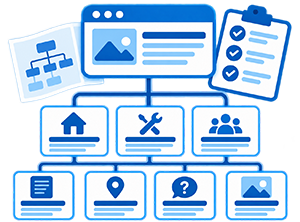
Content Planning and Page Mapping

Search-Focused Content Optimisation
How We Structure Content Across Your Trade Website
Content becomes significantly stronger when every page has a clear role within the wider website. A trade website should not be a collection of unrelated pages competing to explain the same services. It should have a logical structure that connects your business, services, service areas, customer questions and proof of experience. The core structure is: trade business → service categories → individual services → supporting information → evidence → enquiry
Core Service Categories Organise the Main Areas of Work
Individual Service Pages Explain Specific Customer Needs
Supporting Content Answers Questions Around the Service
Case Studies and Project Evidence Support the Relevant Service
Service Area Content Connects Real Services With Real Locations
Internal Links Connect Related Pages
Each Page Should Have One Clear Primary Purpose
Supporting Pages Should Strengthen Commercial Pages, Not Compete With Them
The Website Structure Should Lead Towards an Enquiry
Content Writing for Different Trades

Content Writing for Builders and Property Improvement Trades

Content Writing for Plumbers, Heating Engineers and HVAC Businesses

Content Writing for Electricians and Technical Trades

Content Writing for Roofers and Exterior Trades

Content Writing for Landscapers, Gardeners and Outdoor Trades

Content Writing for Other Local Trades and Service Businesses
Content Writing for Your Service Areas
Most trade businesses depend on winning work from defined towns, cities, regions or service areas. We organise location-focused content around: service → service area → local customer need → enquiry
Service Areas Should Reflect Where You Actually Work
That may include: a town or city, surrounding local areas, a wider county or region, multiple defined service areas, and several branches or operating locations. The relationship is: trade business → service → genuine service area
Location Pages Should Contain Distinct Local Information
Where separate pages are justified, each page should contain information relevant to that location. That may include: genuine services available there, local project examples, relevant customer types, property or service considerations, surrounding coverage, and branch or team information where applicable.
Local Customers Need to Know Whether You Cover Their Area
The relationship is: customer location → service availability → confidence → enquiry
Location Content Should Support a Specific Service
The relationship should be: service → location → customer requirement
Project Evidence Can Strengthen Location Relevance
The structure is: service → location → completed project → evidence → enquiry
Multi-Location Businesses Need a Clear Geographic Structure
A simplified structure may be: business → location → services available → local customer → enquiry or business → service → service areas → local enquiries
Location Content Should Connect to the Wider Website
The relationship can be: service page → location page → local evidence → enquiry and location page → relevant service → quote request
Local Relevance Should Support Leads, Not Just Visibility
The intended structure is: local customer need → relevant service → real service area → confidence → enquiry → quote → booked work
Our Content Writing Process
Business and Existing Content Audit
Customer, Competitor and Search Research
Content Architecture and Page Mapping
Content Brief and Section Planning
Trade-Specific Content Writing
Editing, Proofreading and Accuracy Review
Search, Retrieval and AI Readability Optimisation
Client Review and Approval
Publishing and Internal Linking
Performance Review and Future Content Decisions
Common Content Problems That Cost Trades Enquiries
We work with established locksmith businesses that want a more dependable flow of qualified enquiries from the services and areas they genuinely operate in.
One Page Covers Too Many Services
When one page tries to explain several different services, the main topic becomes unclear. Important services should have dedicated pages where they represent different customer needs.
Several Pages Cover the Same Service
Overlapping pages can weaken relevance and create confusion about which page should rank. Use one primary service page supported by content with clearly different purposes.
Location Pages Are Too Similar
Changing only the town name creates weak location content. Each location page should connect a real service area with relevant local information, customer needs and genuine evidence where available.
Content Focuses on Keywords Instead of Customers
Keyword targeting alone is not enough. Content should start with the customer need, connect it to the right service and provide enough information to support an enquiry.
Content Is Too Generic
Different trades have different services, terminology and customer concerns. Content should reflect the actual trade, service and customer need instead of using generic wording.
AI Content Is Published Without Review
AI-assisted drafts should be checked for accuracy, repetition, terminology, business claims and relevance before publishing.
Important Customer Questions Are Missing
Customers may need answers about suitability, process, cost factors, timing or next steps before requesting a quote. Missing these questions can reduce confidence.
Claims Lack Evidence
Claims such as “experienced” or “trusted” are stronger when supported by real projects, qualifications, guarantees, reviews or other evidence.
Supporting Content Is Disconnected
Blog posts and guides should support relevant commercial services rather than exist as isolated traffic pages.
Calls to Action Are Weak
Each page should make the next step clear, whether that is requesting a quote, calling, asking a question or visiting a relevant service page.
The Website Focuses on Traffic Instead of Enquiries
Traffic and rankings matter, but the main goal is qualified enquiries, quote opportunities and booked work.
Example 90-Day Content Implementation Roadmap
Audit and Content Architecture
Improve Core Commercial Pages
Add Supporting Content
Prioritise Commercial Value
Review and Improve
What’s Included in Our Content Writing Service
Included in the Core Content Writing Service
Search, AEO and GEO Considerations Are Built Into the Content
Optional Publishing and Implementation Support
Ongoing Content Support
Information We Need From Your Business
What Is Not Included Unless Agreed Separately
Revisions Should Follow the Agreed Content Brief
The relationship is: approved brief → draft → factual review → revisions → final content
The Scope Should Stay Focused on Commercial Outcomes
The relationship is: research → planning → content → implementation → qualified enquiry → quote → booked work
Why Choose SEO for Trades for Content Writing

Built Around Trade and Home-Service Businesses
Services and Customer Needs Come Before Keyword Lists
We Answer the Questions That Influence Enquiries
We Connect Service Areas to Real Commercial Relevance
We Build Content Around Commercial Outcomes
Track Qualified Enquiries
We Separate Verifiable Evidence From Marketing Claims
We Keep the Website Taxonomy Clear and Consistent
We Can Support One-Off Projects or Ongoing Content Needs
Content Writing Pricing for Trades
One-Off Content Projects
Full Website Content Projects
What Your Content Quote Should Cover
Why Word Count Alone Is the Wrong Pricing Model
Pricing Should Reflect the Leads You Want to Generate
Request a Content Writing Quote
Content Writing for Trades FAQs
What Is Content Writing for Trades?
Can You Write Content for My Specific Trade?
Can You Rewrite My Existing Website Content?
Yes. We can review your existing pages to identify what should be kept, improved, expanded, consolidated or removed, with the aim of strengthening unclear service descriptions, reducing duplication, improving page structure and making the content more useful to both potential customers and search systems.
Do You Write Service and Location Pages?
Do You Write Blog Content and Case Studies?
Is the Content SEO Optimised?
Do You Optimise Content for AEO, GEO and AI Search?
Can Content Writing Guarantee Higher Rankings or More Leads?
How Much Content Does My Website Need?
How Long Does a Content Writing Project Take?
How Do You Measure Whether the Content Is Working?
Get a Content Plan Built Around Qualified Enquiries