Website Design for Trades That Generates More Qualified Leads

We design and build websites for UK trade businesses that are structured to generate qualified leads, quote requests and booked work. Each website clearly connects your services, service areas, expertise and proof so potential customers can quickly understand what you offer, where you work and why they should choose you. We combine conversion-focused design, clear website architecture, local SEO signals and simple enquiry paths so your business can be understood across Google, local search and AI search systems. The goal is to turn relevant searches into qualified enquiries for the services and locations you want to grow.
★ ★ ★ ★ ★ 5.0
Based on 150+ Reviews
100%
U K. Based SEO
Team
Results
Driven
Oriented
Trades Trust Strip
TRUSTED BY TRADES BUSINESSES ACROSS THE UK
1,200+
Trade Businesses
Helped
4.9 / 5
Average Rating
on Google
250M+
Combined Leads
Generated
95%
Client Retention
Rate
6+ Years
Specialists in Trade
SEO
1,200+
Trade Businesses
Helped
4.9 / 5
Average Rating
on Google
250M+
Combined Leads
Generated
95%
Client Retention
Rate
6+ Years
Specialists in Trade
SEO

Why Your Website Is Not Generating Enough Enquiries

A trades website can look professional and still fail to generate enough qualified leads, quote requests and booked work. The problem is rarely one design issue. It is usually a combination of unclear services, weak location relevance, insufficient proof and difficult enquiry paths. Potential customers need to quickly understand what you do, where you work, why they should trust you and how to contact you. Your website structure should make those relationships clear for both customers and search and AI discovery systems.

Your Services Are Not Clear Enough

Customers usually arrive with a specific job in mind, such as a boiler repair, electrical inspection, roof replacement, extension or bathroom installation. Your website should clearly identify your priority services and organise related services beneath the correct parent categories. Important services may need dedicated pages that explain what is included, who the service is for, where it is available, what proof supports it and how to request a quote.

Your Service Areas Are Ambiguous

Customers need to know whether you work in their location. Generic statements such as “serving customers across the UK” or “covering the local area” create uncertainty when your business actually serves specific towns, cities or regions. Your website should clearly connect: trade business → service → service area → enquiry

Customers Cannot See Enough Proof

Customers need evidence before they trust a trade business with work in their home, property or commercial premises. Relevant proof can include reviews, completed projects, before-and-after photographs, case studies, qualifications, accreditations and applicable guarantees. That evidence should support the service it relates to rather than sit disconnected elsewhere on the website.

The Route to Request a Quote Is Too Difficult

Customers should not have to search for your phone number, enquiry form or quote button. Depending on how your business operates, useful enquiry options can include click-to-call buttons, contact forms, quote forms and messaging options. The goal is to make it easy for suitable prospects to become qualified enquiries.

Your Website Structure Does Not Reflect How Customers Decide

Most customers follow a simple decision path: identify service → confirm location → evaluate business → review proof → request quote Your website architecture should support that same journey.

How Customers Find and Choose a Trades Business

Before requesting a quote, most customers move through a simple decision process. They identify the service they need, check whether the business provides it in their area, evaluate trust and proof, compare suitable options and then decide whether to make contact. The buying journey is: service need → service relevance → location relevance → trust → comparison → enquiry → quote

Customers Start With the Job They Need Done

Most customers begin with a specific problem, service or project. That may be a plumber for a leaking pipe, an electrician for an EICR, a roofer for repairs or a builder for an extension. Your website should therefore organise its content around the services your trade business actually provides.

Customers Check Whether You Cover Their Area

Finding the right service is only part of the decision. Customers also need to confirm that the service is available in their town, city or service area. Your website should clearly connect: business → service → service area rather than leaving that relationship implied.

Customers Look for Reasons to Trust the Business

Once service and location relevance are established, customers look for evidence that the business is credible and capable of completing the work. Relevant trust signals can include reviews, completed projects, photographs, case studies, qualifications, accreditations, guarantees and clear business information.

Customers Compare Suitable Trade Businesses

Potential customers may compare several businesses before deciding who to contact. Your website should quickly answer the questions that influence that decision: what you do, where you work, what you specialise in, what proof supports your work and how to request a quote.

Customers Need an Obvious Next Step

Once a customer is satisfied with your service, location and credibility, the next action should be clear. Depending on the service, that may be calling, submitting an enquiry, requesting a quote or sending a message. The relationship becomes: service → location → proof → contact action → qualified enquiry → quote opportunity

What Is Included in Our Trades Website Design Service

A trades website should not be a collection of disconnected design features. It needs a clear structure connecting your business, services, service areas, proof and enquiry actions so customers can understand what you offer and move towards making contact.

What Is Included in Our Trades Website Design Service

We define your trade, priority services, secondary services, target customers, service areas, available proof, enquiry routes and required pages.

This creates the foundation for the website structure.

Service Page Architecture

Priority services are organised so customers can understand what the service is, what it includes, who it is for, where it is available, what related services exist, what proof supports it and how to request a quote. The hierarchy remains: trade business → service category → individual service → enquiry

Service Area and Location Structure

We structure the website around the locations your business actually serves. For businesses operating in one primary area, clear service-area information may be sufficient. For businesses targeting several commercially important locations, dedicated location pages can be used where each page has a distinct purpose and relevant service context.

Search Visibility Foundations

The website is built with clear technical and content foundations, including logical site hierarchy, descriptive page titles, structured headings, internal linking, service-focused content, location relevance, mobile usability, XML sitemap setup and Google Search Console configuration where included. These elements help search engines crawl, understand and index the website correctly.

AI Discovery and Answer Engine Foundations

Important business information is structured so search and AI systems can clearly understand who the business is, what services it provides, where it operates, what evidence supports it and how customers can make contact. This improves the clarity of the relationships between your business, services, locations and proof across search engines, answer engines, retrieval systems and LLM-assisted discovery systems. AEO and GEO support the website’s broader search visibility rather than functioning as separate primary services on this page.

Mobile-Friendly Website Development

Services, contact details, quote actions, reviews and service-area information are designed to remain clear and accessible across mobile devices.

Fast and Secure Website Development

The website is developed with reliable performance, secure HTTPS connections and appropriate technical foundations for usability, crawling and ongoing maintenance.

Lead and Quote Generation Features

Depending on how your trade business handles enquiries, the website can include click-to-call buttons, contact forms, quote request forms, messaging options and service-specific calls to action.

Reviews, Projects and Trust Signals

Customer reviews, completed projects, case studies, qualifications, accreditations and relevant guarantees can be integrated into the pages where they directly support the service being considered.

Website Analytics and Enquiry Tracking

Where included, meaningful actions such as contact form submissions, quote requests and telephone clicks can be measured. The purpose is to understand whether the website is contributing to qualified leads, quote opportunities and booked work, rather than reporting traffic alone.

How We Structure Your Trades Website

A trades website needs a clear hierarchy that connects your business, services, locations, proof and enquiry routes.

The core relationship is:

trade business → service category → individual service → service area → proof → enquiry

01

Core Business Pages

The core pages establish the main business entity and provide the foundation for the rest of the website.
These can include the homepage, about page, services overview, contact page and project or case-study hub.
Together, they explain who the business is, what trade services it provides, where it operates, what evidence supports its work and how potential customers can make contact. Service, location and proof pages should connect back to these core business pages rather than functioning as isolated sections.

02

Service Pages

Commercially important services can have dedicated pages within the correct service hierarchy.
For example:
electrician → electrical services → rewiring
or:
builder → building services → extensions
Each service page should clearly explain the work provided, relevant locations, supporting proof and the next step toward an enquiry.

03

Service Area Pages

Location content explains where your services are genuinely available.
A useful service-area page can connect the location with relevant services, nearby coverage, completed projects, local proof and the appropriate enquiry route.

04

Service and Location Relationships

Services and locations should support each other rather than exist as separate content silos.
For example:
roofing company → roof repairs → Bexley
This makes the relationship between the business, service and target area explicit.

05

Project and Case Study Pages

Project and case-study pages can connect:
service → location → customer type → work completed → evidence → outcome
They provide proof that supports the services and locations being targeted elsewhere on the website.

06

Reviews and Testimonials

Reviews are strongest when placed alongside the service, project or location they help validate rather than being isolated on a generic testimonials page.

07

Qualifications, Accreditations and Guarantees

Relevant qualifications, accreditations and guarantees should be displayed only where they are genuine and applicable.
Their relationship to the business or specific service should be clear.

08

Internal Linking Between Related Pages

Internal links should connect logically related pages and entities, such as:
service → project
service → location
location → service
project → service
project → enquiry
This helps customers and search systems understand how the website’s key entities relate to one another.

09

Enquiry Paths Across the Website

Every important commercial page should provide a clear next step toward a phone call, enquiry or quote request.
The final relationship should remain:
service → location → proof → enquiry

Who We Design Websites For

Trade businesses do not all require the same website structure. The right architecture depends on the services offered, locations covered, business size, growth plans and how customers make buying decisions.

Sole Traders and New Trade Businesses

A smaller trade business may need a focused website covering its core services, primary service area, trust signals and contact options. The priority is clear positioning and straightforward enquiry paths rather than a large number of pages.

Established Trade Businesses

Established trade companies may need a broader website structure with multiple service pages, stronger project evidence, reviews, service-area coverage and different enquiry routes for different types of work.

Growing Trade Businesses

A growing trade business needs a scalable website architecture that allows new services, locations, projects and supporting content to be added without weakening the existing hierarchy.

Multi-Service Trade Businesses

Businesses offering several trade services need those services grouped into clear parent categories and individual service pages rather than compressed into one generic services section. The structure may follow: trade business → service category → individual service → enquiry

Trade Businesses Serving Multiple Locations

Businesses genuinely operating across several towns, cities or regions may need a scalable service-area structure that clearly connects relevant services with the locations where they are available.

Trade Businesses That Rely on High-Value Quotes

Businesses selling higher-value work such as extensions, renovations, roof replacements, landscaping projects, kitchens or bathrooms usually need stronger project evidence, detailed service information and clearer trust signals before customers are ready to enquire.

Trade Businesses That Need Better-Fit Enquiries

For businesses receiving too many unsuitable leads, the website can place greater emphasis on priority services, genuine service areas, customer suitability and enquiry qualification. The aim is to generate fewer irrelevant enquiries and more opportunities for the work the business actually wants. is it strong

Website Design for Different Trades

Different trades require different relationships between services, service areas, proof, trust signals and enquiry paths.

Websites for Plumbers and Heating Engineers

Relevant service entities can include plumbing repairs, boiler servicing, heating systems, bathroom installations and emergency work. The website should clearly separate urgent services from planned installations and connect each service with the locations covered, relevant reviews and the appropriate enquiry action.

Websites for Gas Engineers

Gas-related websites may need to connect boiler services, heating work, landlord gas safety and other relevant services with genuine Gas Safe registration, customer reviews, service areas and clear contact options.

Websites for Electricians

Relevant services can include rewiring, EICRs, consumer units, lighting, electrical installations and EV charging. Service pages should make it clear which work is offered, where it is available and what qualifications, project evidence or reviews support it.

Websites for Builders and Bricklayers

Building businesses may need dedicated pages for extensions, renovations, conversions, brickwork and larger construction projects. Case studies, completed projects, photographs and detailed project evidence become especially important because customers often compare several contractors before requesting a quote.

Websites for Roofers

Relevant services can include roof repairs, roof replacements, flat roofing, pitched roofing and associated roofing work. The website should separate these services clearly and support them with project evidence, reviews, service areas and appropriate quote actions.

Websites for Carpenters and Joiners

Services such as fitted furniture, doors, flooring and bespoke joinery benefit from clear service categorisation and strong visual evidence. Project galleries and completed-work examples can help customers evaluate workmanship before making an enquiry.

Websites for Painters and Decorators

Painting and decorating websites can organise services around interior work, exterior work, residential projects and commercial decorating where relevant. Before-and-after photographs, reviews and completed projects can help demonstrate finish quality and build confidence.

Websites for Plasterers and Tilers

Clear service categories combined with photographs, completed projects and reviews can help customers understand the work offered and evaluate finish quality.

Websites for Kitchen and Bathroom Fitters

Higher-value installation projects often require detailed service information, project galleries, before-and-after evidence, customer reviews and stronger quote qualification. The website should help potential customers understand the type of projects the business takes on before they make contact.

Websites for Landscapers

Relevant services can include patios, paving, fencing, decking, turfing and garden landscaping. Strong project photography, location relevance and service-specific pages can help customers evaluate the business before requesting a quote.
Website Design for Trades

Websites for Other Local Trades

The same structural principles can support locksmiths, glaziers, fencing contractors, handyman businesses and other local trade services.
The parent relationship remains:
trade → service category → individual service → service area → proof → enquiry

Location Structure for UK Trade Websites

Location content should accurately reflect where the trade business actually operates and how its services relate to those areas.

Websites for Trades Serving One Local Area
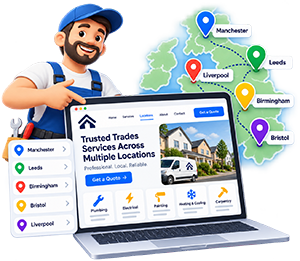
A trade business serving one primary location may only need clear service-area information rather than multiple location pages. The priority is to make the relationship between the business, services and main operating area explicit.

Websites for Trades Serving Multiple Locations

Dedicated location pages may be appropriate for commercially important towns or cities where the business genuinely provides services and can add useful local context. Each page should connect the location with relevant services, proof and an appropriate enquiry route.

Websites for Trades Covering a Wider Region

Larger regional businesses can use a geographic hierarchy such as: region → priority locations → available services → enquiry This creates a scalable structure without treating every location as equally important.
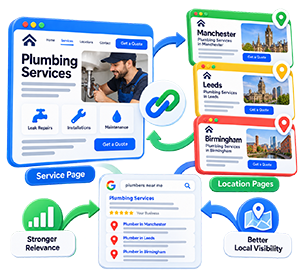
Service and Location Pages Should Work Together
Customers want to know whether a specific service is available in their area. The website should therefore connect service pages and location pages logically without creating every possible service-and-location combination as a separate page.

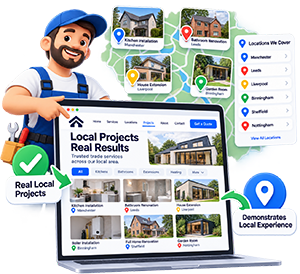
Use Local Projects as Geographic Proof

Completed projects can strengthen both service and location relevance. A useful relationship is: service → location → completed work → evidence → review → enquiry
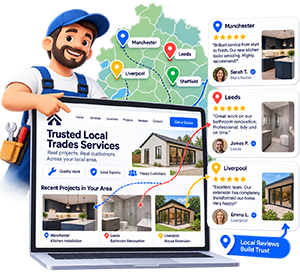
Use Reviews Where They Support the Location
Genuine customer reviews can reinforce geographic relevance when the review naturally identifies the area, project or service involved. Location references should come from real customer or project context rather than being added artificially.

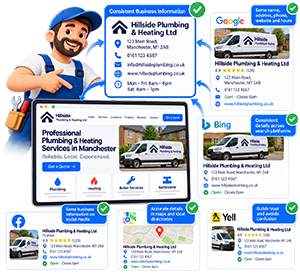
Keep Business Information Consistent

The business name, telephone number, core services and genuine service areas should remain consistent across the website and relevant external business profiles.

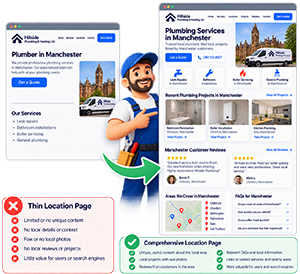
Avoid Thin Location Pages

A location page should have a clear commercial and informational purpose. It should not exist simply to replace one town or city name with another while keeping the rest of the content substantially unchanged.

Location Structure Should Support Better-Fit Leads

The objective is not to create the largest possible location footprint. It is to make the business visible and relevant in the areas where it can genuinely provide the services customers are searching for and take on profitable work.

Our Trades Website Design Process

Our website design process moves from understanding your trade business to planning, building, testing and launching a website structured around services, locations, proof and enquiry generation.
STEP 01

Discovery and Business Research

We identify your trade, priority services, target customers, service areas, high-value work, available proof and the types of enquiries you want to generate. This gives the website a clear commercial direction from the start.
STEP 02

Website Architecture and Page Planning

We determine which core business pages, service pages, location pages, proof pages and contact routes are required. Each page is given a defined role so the website follows a clear hierarchy rather than becoming a collection of disconnected pages.
STEP 03

Content and Relationship Mapping

We map the important relationships across the website: business → trade → service category → individual service → location → proof → enquiry This helps ensure that each page supports the correct parent topic and connects logically with related services, locations and evidence.

STEP 04

Content, Design and Development

Website content is developed around the questions potential customers need answered: Can you do the work?
Do you cover my area?
Can I trust your business?
How do I request a quote? The website is then designed and built around clear navigation, mobile usability, service hierarchy, trust signals and visible enquiry actions.

STEP 05

Search and AI Discovery Setup

Where included, we implement appropriate technical and content foundations such as page titles, heading structure, internal links, XML sitemap setup, Google Search Console configuration and suitable structured data. These elements help search engines and AI-assisted systems understand the relationship between the business, services, locations and supporting evidence.
STEP 06

Review, Testing and Approval

Before launch, you review important factual information including services, service areas, credentials, project details, contact information and other business claims. We also test key customer journeys across relevant devices, including navigation, forms, click-to-call actions, quote buttons and other enquiry routes.
STEP 07

Website Launch and Post-Launch Support

The website is published after client approval and final technical, content and functionality checks. Where included, post-launch support can cover technical monitoring, maintenance, updates and website changes.

Common Trades Website Mistakes That Cost You Enquiries

A trades website can lose potential customers when its services, locations, proof, usability or enquiry paths are unclear.

Unclear Service Structure

Important services should not be buried on one generic page. Commercially important work may need dedicated pages within a clear service hierarchy.

Thin or Weak Location Pages

Location pages should connect genuine service areas with relevant services, proof and enquiry options rather than simply changing town names.

Difficult Enquiry Paths

Phone numbers, forms, quote buttons and messaging options should be easy to find without creating unnecessary friction.

Weak or Disconnected Proof

Reviews, projects, photographs, qualifications and accreditations should support the services customers are considering.

Poor Mobile Experience

The full journey from service discovery to enquiry should work clearly across mobile devices.

Writing for Keywords Instead of Customers

Content should explain services, locations, suitability and proof rather than repeat search terms.

Creating Pages Without a Clear Hierarchy

Every important page should connect logically within the website:
trade business → service → location → proof → enquiry

Measuring Visibility Instead of Enquiries

Rankings and traffic can support diagnosis, but the commercial objective remains qualified leads, quote opportunities and booked work.

Why Choose SEO for Trades for Website Design

A trades website should do more than look professional. It should help the right customers understand your services, confirm that you work in their area, trust your business and take the next step toward an enquiry or quote. Our approach combines trade-focused website design, search architecture, local relevance, proof and conversion planning from the beginning of the project.

Built Specifically for Trade Businesses

We design websites around the way trade businesses actually operate. That means structuring the site around services, service areas, project evidence, reviews, credentials and enquiry routes rather than forcing your business into a generic corporate template.

Focused on Qualified Leads and Quote Opportunities

The website is built around commercial actions such as phone calls, enquiry forms and quote requests. The objective is not simply to increase visits. It is to help more suitable potential customers contact your business about the services and locations you want to grow.

Website Architecture and Search Built Together

Search structure is considered during the website build rather than added later as a separate layer. We plan service categories, individual service pages, location relationships, internal links and supporting proof so the website has a clear hierarchy from launch.

Search and AI Discovery Foundations

We organise important business information so the relationships between your business, services, locations and evidence are clear. This helps customers, search engines, retrieval systems and AI-assisted discovery systems better understand what your business does, where it operates and what supports its credibility.

Built Around Your Priority Work

Not every service needs the same level of emphasis. We structure the website around the jobs, services, locations and customer types your business actually wants more enquiries for, helping the site support commercial priorities rather than treating every service equally.

Proof Is Connected to the Services It Supports

Reviews, projects, case studies, photographs, qualifications and accreditations are stronger when they appear in the right commercial context. We connect relevant proof with the services and locations it helps validate rather than leaving important trust signals isolated elsewhere on the website.

Clear Enquiry Paths Across the Website

Customers should always understand what to do next. Important commercial pages can include clear calls, quote actions, contact forms or messaging options so the journey from service discovery to enquiry remains simple.

Scalable Structure for Future Growth

The website can be planned so new services, locations, projects and supporting content can be added later without weakening the existing hierarchy. This is especially important for trade businesses planning to expand into new service areas or higher-value work.

Clear Scope and Communication

You should understand what is included in the website project, which elements require ongoing work and why each important page exists. The aim is to create a website with a clear relationship between: trade business → services → service areas → proof → enquiry → quote opportunity

Trades Website Design Pricing

Website design costs depend on the scope of the project, including the services, locations, content, functionality and level of support required.

A focused sole-trader website will usually require less work than a multi-service trade business targeting several locations.

For full package details, inclusions and ongoing service options, view our Website Design Pricing page.

Frequently Asked Questions

The cost depends on the structure, number of services and locations, content requirements, integrations and enquiry functionality. A smaller website will usually cost less than a multi-service business website with several location pages, case studies or custom features.
Timescales depend on the number of pages, content requirements, functionality and how quickly the required business information and approvals are provided.
The website can include agreed SEO foundations such as page architecture, titles, headings, internal linking, service-focused content and technical setup. Ongoing SEO is a separate service where continued growth is required.
The initial build can include clear entity relationships, structured business information and content architecture that support search, answer-engine and generative-search understanding. Ongoing AEO or GEO work may require continued content, authority and entity development.
Yes. A redesign can improve website structure, content, mobile usability, enquiry paths, technical foundations and presentation rather than simply changing how the site looks.
Yes, where individual services represent distinct customer needs and have enough commercial importance to justify dedicated pages.
Yes, where your business genuinely serves those locations and each page can provide useful local context. We do not recommend creating large numbers of near-identical location pages simply to target place names.
Hosting and maintenance can be included or quoted separately depending on the agreed project scope.
Yes. Reviews, project galleries, case studies and photographs can be integrated into the pages where they provide the strongest support for the relevant service or location.
No responsible provider can guarantee a specific organic ranking. The website can be built with strong technical, structural and content foundations, but rankings depend on competition, authority, relevance and ongoing SEO factors.
No provider can guarantee citations or recommendations from a specific AI system. What we can do is structure your business, services, locations and supporting evidence clearly so search engines and AI-assisted discovery systems have stronger information to interpret.

Get a Quote for Your Trades Website

Your website should do more than look professional. It should help the right customers find your services, confirm you work in their area, trust your business and take the next step.
Tell us your trade, priority services, service areas, the type of work you want more of and whether you already have a website.
We can then recommend the structure needed to connect:
trade business → priority services → service areas → proof → qualified enquiry → quote opportunity → booked work

security seo services